
Why the Black Diamond Vision Harness Recall Is Still Worth Discussing
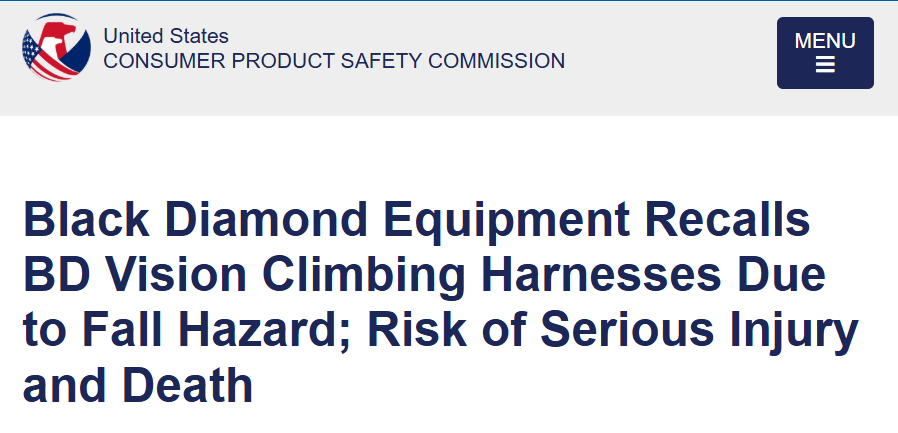
The Black Diamond Vision Harness recall happened some time ago, but the case is still worth revisiting.
For the climbing and outdoor industry, the value of a recall is not only in understanding what went wrong with one product. It also gives manufacturers, brands, and buyers a chance to look again at how product safety is built into the entire development and production process.
For carabiners and outdoor hardware, that matters.
A carabiner may look like a simple metal component, but its reliability depends on much more than appearance. Material choice, structure, gate design, breaking strength, surface treatment, production tolerance, and long-term use can all affect performance.
This is why safety-related outdoor hardware should never be evaluated by one test result alone.
A product may pass an initial load test, but real-world use is very different from a laboratory test. Outdoor hardware can be exposed to repeated loading, moisture, temperature changes, dirt, scratches, corrosion, impact, and thousands of opening and closing cycles.
The more important question is not only whether a product can pass a test once.
It is whether the product can continue to perform consistently over time.
That is one of the key lessons behind cases such as the Black Diamond Vision Harness recall.
Reliability Starts With the Right Material and Structure
Material selection is one of the first decisions in product development.
Different applications require different combinations of strength, weight, corrosion resistance, durability, and cost. Aluminum alloys are widely used where lightweight performance is important, while steel may be more suitable for applications where higher strength and wear resistance are required.
But material alone does not determine performance.
Structure is equally important.
Two carabiners may look very similar, but differences in body shape, wall thickness, gate design, locking mechanism, and manufacturing tolerance can lead to very different results under load.
That is why professional product development should always begin with the intended application, not simply with the appearance of the product.
Testing Should Reflect Real Use
Breaking strength is an important specification, but it is only one part of the picture.
For outdoor and climbing hardware, other factors also matter:
- repeated loading
- gate opening and closing cycles
- corrosion resistance
- surface treatment durability
- dimensional consistency
- long-term wear
- environmental exposure
These factors are especially important for products used in demanding outdoor conditions.
A good sample is not enough.
The real challenge is making sure that mass production remains consistent from batch to batch.
That requires control over raw materials, machining, assembly, finishing, inspection, testing, and production records.
Why Buyers Should Look Beyond Price
Price will always be an important part of sourcing.
But for outdoor hardware, it should not be the only comparison.
A responsible sourcing decision should also consider how the supplier controls materials, production tolerances, gate performance, surface treatment, testing, and traceability.
For buyers, asking the right questions early can reduce problems later.
What material is being used?
What load requirement is needed?
How will the product be used?
Will it be exposed to rain, salt, low temperatures, or high humidity?
How often will the gate be opened and closed?
What testing is needed before mass production?
These questions help define the right manufacturing solution before production begins.
Quality Begins Before Final Inspection
At Shichuang (SAMHE), carabiners and outdoor hardware are developed around the actual application.
Material selection, structure, surface treatment, testing requirements, and production methods should all be considered before mass production starts.
This is because quality is not created at the final inspection stage.
It begins much earlier.
The Black Diamond Vision Harness recall is one case in the climbing industry, but the wider lesson applies to many outdoor products.
For safety-related equipment, every component matters.
And sometimes, a small component can still be part of a much larger safety system.
A small component is never just a small component.
Shichuang (SAMHE) provides OEM and customized solutions for carabiners and outdoor hardware across climbing, hiking, outdoor, luggage, pet, apparel, and promotional applications.
subscribe our youtube