
Why Choosing the Right Climbing Carabiner is Important?
In outdoor activities such as rock climbing, mountaineering, and high-altitude work, carabiners are a crucial link connecting ropes, anchor points, and the human safety chain. A qualified carabiner must meet stringent safety standards and perform its corresponding function in the correct usage scenario. So choosing the right climbing carabiner is important.
For brands and procurement, scientifically choosing carabiners not only relates to the safety of end-users but also directly affects product reputation and compliance.
First, check certifications and strength parameters
When choosing any carabiner for load-bearing and protection, the first step is to confirm whether it has passed authoritative certification and check the strength parameters engraved on the main beam.
Certification Marks
CE (compliant with EU standards such as EN 12275) and UIAA (International Climbing and Mountaineering Federation) are currently common safety certification marks, indicating that the carabiner has passed strength and safety performance tests under specified testing conditions.
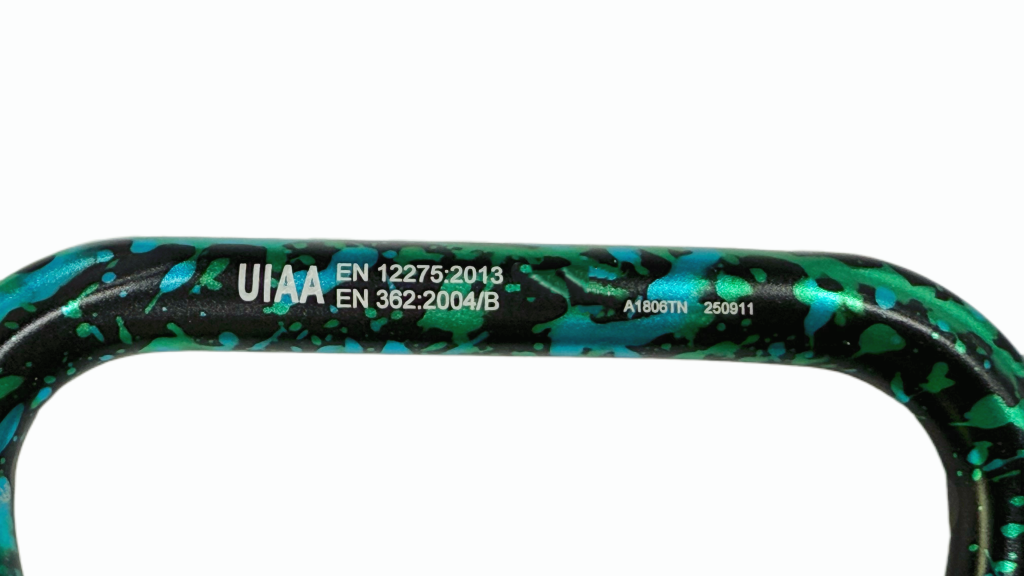
Three Key Strength Values
- Main Beam Locking Strength: Strength along the main beam in the closed state. Most climbing carabiners have a strength of around 22–30 kN, suitable for withstanding fall impacts.
- Secondary (lateral) strength: Strength under lateral force, typically not less than 7 kN, but significantly lower than the main shaft strength. Therefore, avoid applying lateral force as much as possible during use.
- Gate opening strength: Strength when the door is open, generally 5–7 kN, about one-third of the main shaft locking strength. Therefore, the carabiner should be kept in an open or partially open state under stress.
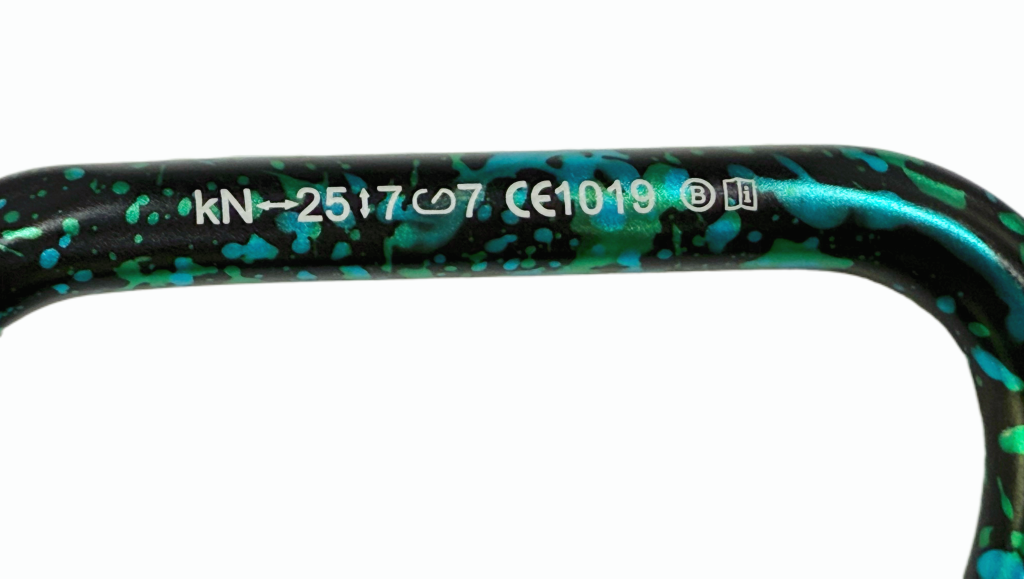
Samhe’s existing climbing/mountaineering series buckles all use aerospace-grade 7075 aluminum, with a main shaft strength of 22–42 kN. The three-dimensional strength is clearly engraved on the product label for easy identification of load-bearing capacity by end users.
Understanding the basic structure of a carabiner:
A standard carabiner mainly consists of a Frame, Spine, gate, and nose.
Gate: The only moving part used to open and close the carabiner. The lighter the weight, the less likely it is to “swing” during impact, causing accidental opening. There are many types, such as two-section locks, three-section locks, straight doors, spring doors, and nut locks.
Spine: The side opposite the door, it bears the strongest load of the main shaft. Keep the rope and the direction of force aligned with the main beam as much as possible.
Nose and Gate Structure: Determines whether the door closes smoothly and whether it’s easy to snag ropes or onto hooks/gear rings. For example, the Keylock structure reduces the risk of snagging.
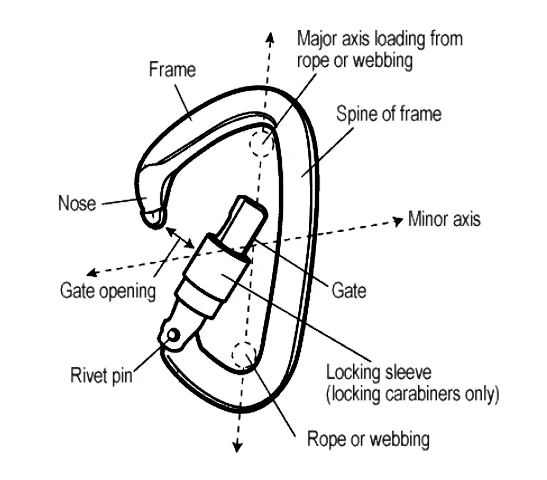
When designing and selecting, ensure that the rope or webbing stays close to the main beam under stress, rather than concentrated on the door or sharp edges, to fully utilize the product’s strength.
Common Carabiner Shapes: How to Choose?
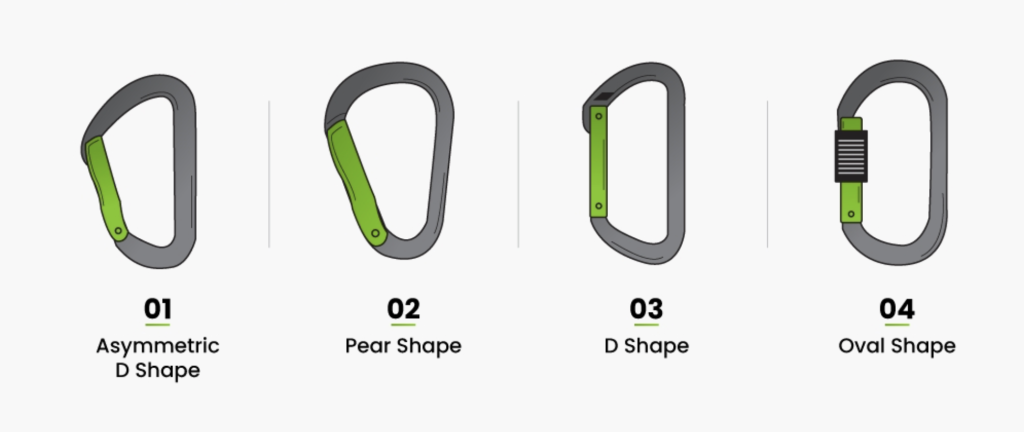
Different carabiner shapes offer different advantages. A proper combination of shapes is fundamental to professional equipment configuration.
D-shape/Asymmetric D-shape (Basic/Asymmetric D): Concentrates more stress on one side of the main beam, resulting in higher strength for the same weight. It’s a common shape for quickdraws and belay point connections.
Asymmetric D-shapes offer larger openings and lighter weight, suitable for everyday sport climbing and multi-purpose use.
HMS/Pear/Type H: Offers ample top space, ideal for Munter (half-slip knot) belaying and belay stations with multiple ropes and slings.
Oval: Distributes stress relatively evenly and has a large space, suitable for use with pulleys and equipment, but its strength and weight are generally average, and it’s no longer a mainstream choice for belay points.
Typically used with carabiner doors, it’s one of the preferred shapes for belaying, rappelling, and establishing anchor points.
Samhe’s climbing series offers a choice of high-strength D-shape quickdraws, oval 7075 aluminum carabiners, and pear-shaped HMS carabiners. Covering various configurations from sport climbing to multi-anchor station setups.
Carabiner vs. Non-carabiner: When to Use Which?
Carabiners are broadly categorized by locking mechanism: non-carabiner (standard door) and carabiner (with additional locking mechanism). The two types are suitable for different scenarios.
Snapgate: Straight, Bent, or wire gate structure, quick opening and closing. Suitable for quick-release attachments, equipment carrying, and non-critical life protection points.
The key is to prevent the door from being impacted outwards, avoid lateral forces, and ensure it won’t open on its own during movement.
Locking Carabiner: Suitable for all “life-critical points”. Protector connection to safety belts, top protection points, main protection stations, descent connection points, etc.
Screwgate: Classic, intuitive, and versatile, but be aware that prolonged friction can cause the screw sleeve to loosen gradually, requiring regular inspection.
Twist-lock, Tri-lock, etc.: Locks automatically upon closing, offering greater security. Suitable for scenarios involving frequent opening and closing but requiring reliable closure, such as protection and descent.
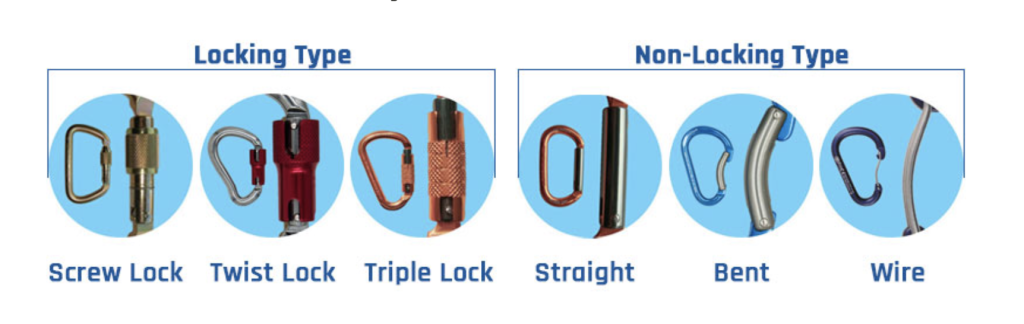
Samhe’s climbing series offers a variety of carabiners. Including manual twist locks, two-stage automatic locks, and three-stage safety locks, with strengths up to 29–30 kN. These are suitable for brands and clubs to provide standardized carabiner solutions for different routes.
Carabiners are not suitable for climbing
Many similar-looking “material clips” and “keychains” exist on the market, but they do not meet any climbing standards and lack CE/UIAA strength markings.
Characteristics: Typically lacks a kN strength value and EN/UIAA certification markings. They are only used for attaching lightweight items such as keys, water bottles, and backpack accessories.
Samhe also manufactures gift/material clips and high-strength carabiners for climbing. Clearly distinguishing their intended use in product descriptions and labeling to help brands and end-users avoid misuse.